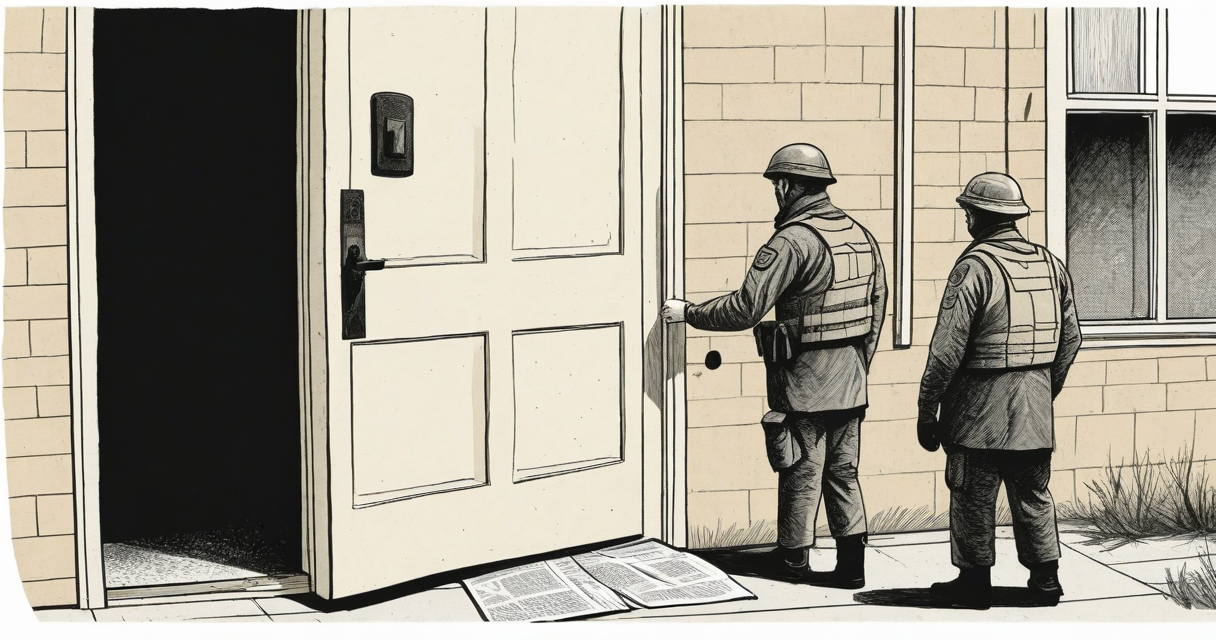
Dutch police seized the provider
Dutch authorities seized 800 servers from a hosting firm for enabling cyberattacks. The provider tier is no longer treated as neutral.

Dutch authorities seized 800 servers from a hosting firm identified as enabling cyberattacks. The action targets the infrastructure layer directly, not the tenants operating on it. The stated condition is enablement. That word matters. It places the provider inside the attack chain, not adjacent to it.
This is not a tenant-level takedown processed through abuse channels. It is a removal of the provider’s operational capacity at scale. Eight hundred servers is the stated count. The specific identity of the firm, the customers hosted on those servers, the categories of cyberattack involved, and the duration of the activity are not confirmed in the facts provided.
What is confirmed is the shape of the action. A state authority judged the hosting environment itself to be the locus of harm and acted against the operator. The standard model where hosting is treated as neutral transport does not apply to this case. The provider was treated as a party to the activity, and the response matched that classification.
The default operating assumption across most enterprise threat models treats hosting providers as neutral intermediaries. They route traffic, lease compute, respond to abuse reports, and sit outside the attack lifecycle for modeling purposes. Detection logic focuses on tenant behavior. Attribution stops at the IP or ASN. Takedown requests follow abuse contact procedures. The provider is treated as a channel, not a participant.
This assumption is a simplification. It exists because the alternative, modeling every transit and compute provider as a potential adversary, is operationally unworkable for most defenders. So the threat model draws the boundary at the tenant and trusts the provider tier to remain out of scope. Identity boundaries are defined per workload. Trust is extended to the underlying infrastructure by default.
The assumption has known failure modes. Hosting environments that ignore abuse complaints, registrars that protect malicious tenants, and infrastructure operators who price their service against the level of operator scrutiny they will accept have existed alongside legitimate providers for a long time. The assumption did not deny this. It deferred it. The provider tier was treated as someone else’s enforcement problem, typically law enforcement or upstream peers. Defenders worked around the gap rather than closing it.
The seizure moves the unit of enforcement from the tenant to the provider. 800 servers were taken. The action was directed at the hosting firm, not at specific customers identified on those servers. The boundary that historically separated the operator from the activity on its platform was not honored in this case.
For the provider tier, this redefines the operating boundary. If the firm itself is judged to be enabling attacks, the entire footprint becomes available for state action. Customer separation, contractual neutrality language, and tenant isolation do not insulate the provider from consequences tied to the aggregate behavior on its platform. The enablement determination collapses the distinction between operator and operation.
For any workload that was running on those servers, the outcome is direct. The compute is gone. Continuity, recovery paths, and data access for tenants operating on that infrastructure are not addressed in the facts provided and are not confirmed. What is confirmed is that the provider’s enablement was the trigger, and the tenants inherited the result. The action did not negotiate with the tenant layer. It removed the layer beneath it.
The drift was structural. Defenders modeled the tenant. Law enforcement modeled the provider. Neither party owned the space between them. The hosting tier sat in a jurisdictional and operational gap where aggregate harm could accumulate without any single defender being responsible for measuring it. The tenant-level threat model had no field for provider posture. The law enforcement process had no continuous telemetry from the defender side. Each party operated on its own surface and trusted the other to handle the rest.
Inside that gap, the enablement condition formed. A provider that does not enforce abuse, does not verify identity at signup, does not respond to takedowns, and does not separate workloads creates an environment where attacker workloads behave the same as legitimate workloads from the platform’s point of view. Enforcement that depends on the operator’s cooperation does not function when the operator’s commercial model is shaped around the absence of that cooperation. The control was named. The control was not enforced. Under the operating philosophy that controls which are not enforced are not controls, the abuse process at this provider was not a control. It was a label.
The Dutch action did not introduce a new mechanism. It applied an existing one, criminal seizure, to a layer that had been treated as out of reach. The drift was the assumption that this layer would remain out of reach. Eight hundred servers is the stated count of the correction. The number describes the scale of what had accumulated under the prior assumption. It does not describe attacker behavior, dwell time, or victim count, none of which are confirmed. It describes the size of the gap that defenders and operators had collectively agreed not to close.
The same mechanism applies to any tier where enforcement is named but not executed and where the operator’s commercial incentives are not aligned with the control. Domain registrars that accept anonymous registration at volume, payment processors that do not validate merchant identity, and bulletproof email relays operate on the identical pattern. The control surface exists in policy. The enforcement surface does not exist in practice. Attacker workloads use the tier the same way legitimate workloads do, because the tier does not differentiate. Aggregate harm accumulates at the operator. The operator is treated as neutral until a state authority decides it is not.
The condition that converts a tier from neutral to in-scope is the enablement determination. In the seized hosting case, the determination was made externally by Dutch authorities based on facts not provided. The mechanism of the determination is what defenders should extract. Once an infrastructure operator is judged to be a party to the activity it hosts, tenant separation does not function as a shield, contractual neutrality does not function as a shield, and the entire footprint becomes available for action. This is true at every tier that depends on the operator-as-neutral framing to keep itself out of scope. The framing is conditional, not permanent.
For defenders operating workloads on third-party infrastructure, the parallel is direct. The provider tier carries a risk that is not addressed by tenant-side controls. If the provider is determined to be enabling, the tenant inherits the seizure regardless of its own posture. This is not a hypothesis about attacker behavior. It is an observation about how enforcement now reaches across the tenant boundary when the operator is judged to be inside the chain. Workload placement is a control decision. The posture of the underlying provider is part of the workload’s exposure surface. It is not external to it.
Hosting is not neutral. The neutrality framing was a working assumption maintained by defenders, regulators, and operators in parallel. It is no longer reliable. When a state authority can act against the provider tier at the scale of 800 servers based on a determination of enablement, the provider tier is in scope. It is in scope for the operator, who can lose the platform. It is in scope for the tenant, who can lose the workload. It is in scope for the defender, who can lose visibility and continuity in a single action that did not originate from the tenant’s own behavior.
The operator position is the following. Provider posture is now a control input. Workload placement decisions must include the enforcement behavior of the provider, not only its technical capability and price. A provider that does not enforce abuse, does not verify identity, and does not separate workloads is a provider that has accepted the conditions under which a state authority may decide to act against it. Workloads placed on that provider carry the same exposure. The control failure does not have to be the tenant’s to produce a tenant outcome.
For providers, the position is simpler. Enablement is now an externally assessable condition with a defined consequence. A control that exists only in policy is not a defense against that assessment. The 800 servers are the demonstration. The firm operated the infrastructure. The firm was judged to be inside the chain. The firm lost the infrastructure. Any provider whose enforcement surface does not match its policy surface is operating under the same conditions and should plan accordingly. Identity is the boundary. Trust must be continuously validated. If a system allows it, it will happen, and the operator will be held responsible for having allowed it.
Keep Reading
 GrapheneOS
A claim, not a control
GrapheneOS rewrote its Messages app under a privacy and security claim, but the enforcing controls are not named or independently verifiable.
 reverse engineering
I reverse-engineered a 2002 GameCube before doing it legally
Decomp Academy turns matching decompilation into a teachable, verifiable skill, which exposes why compiled opacity was never a real security control.
 operational security
They knocked on his door, not his firewall
Danish police raided privacy activist Lars Andersen with no technical breach. The boundary moved to physical custody, where remote controls were never positioned.
Latest on the Wire
Full wire →- 3Blue1Brown: As AI Cracks Proofs, Math Must Reward 'Motivated Explanations'Hacker News
- A Rust veteran ports a JSONPath library to Zig — and rethinks his habitsHacker News
- AI Model Reportedly Cracks an Unsolved 1918 German ADFGVX CipherHacker News
- Beating Chrono Trigger's Dream Devourer With an Integer OverflowHacker News
New signal daily · RSS
Stay in the loop
New writing delivered when it's ready. No schedule, no spam.